How to Choose the Right Beat for Your Song
You've been scrolling BeatStars for two hours. Every beat sounds fire for the first eight bars, but the moment you try to rap over it, something feels off. Your flow stumbles, the melody clashes with your voice, or the energy just doesn't match what you're trying to say. Picking beats online is one of the most underrated skills in an artist's toolkit, and getting it wrong costs you money, studio time, and momentum.
The truth is that the best beat for your rap song isn't necessarily the one with the hardest 808s or the catchiest melody. It's the one that makes space for your voice, matches the energy of your lyrics, and gives your performance room to breathe. Let's break down exactly how to find that beat every single time.
Understanding BPM and How It Affects Your Flow
BPM, or beats per minute, is the heartbeat of your song. It dictates the speed at which you deliver your bars, the energy the listener feels, and even the emotional tone of the track before a single word is spoken.
Here are the ranges that matter. Storytelling rap and introspective tracks often live in the 60 to 80 BPM range. This is where artists like J. Cole and Kendrick Lamar operate when they want every word to land with weight. The mainstream sweet spot for Hip-Hop and Pop often sits between 85 and 105 BPM, giving you enough room for both melodic flows and punchline-heavy verses. High-energy genres like Drill, Jersey Club, and uptempo Pop often push into the 110 to 150 BPM territory, demanding fast delivery and aggressive cadences.
The mistake most beginners make is picking a beat purely because it sounds good in isolation without considering whether their natural delivery speed matches the tempo. If you're a rapper who thrives on dense multisyllabic rhymes, a 140 BPM drill beat might leave you breathless by the second verse. If you're a melodic artist who stretches syllables across bars, a 70 BPM beat gives you the canvas you need. Before you even browse a single beat store, know your comfortable tempo range. Open your phone's metronome app, freestyle for sixty seconds, and note where you naturally land.
Key and Mood: Why They Matter
Every beat is written in a musical key, and that key carries an emotional signature. Minor keys sound darker, sadder, and more introspective. Major keys feel brighter, more uplifting, and energetic. This isn't just music theory abstraction; it directly affects how your voice interacts with the instrumental.
If you're writing a breakup track and the beat is in a major key with bright, happy chords, your words and the music will pull the listener in opposite directions. The emotional disconnect will make the entire song feel inauthentic even if the lyrics are brilliant. Conversely, pairing aggressive battle rap lyrics over a melancholy minor key beat creates a tonal mismatch that confuses the listener's subconscious.
You don't need to be a music theory expert to get this right. Tools like Antares Auto-Key, Mixed In Key, or built-in DAW detection can help identify the key of a downloaded beat, but treat pricing and subscriptions as current-check items because plugin lineups change. Once you know the key, hum your melody or rap your hook and listen honestly. Does your voice feel at home in that tonal space, or are you straining to hit notes that don't fit your natural range? If you're forcing it, the audience will hear the effort even if they can't explain why.
Genre Matching: Trap vs. Boom Bap vs. R&B Beats
The boundaries between genres keep dissolving. Hybrid styles like PluggnB, rage, melodic drill, and R&B-trap blends prove that artists do not have to stay inside one clean category. But understanding the core characteristics of each genre still gives you a foundation to make smart choices.
Trap beats are defined by rolling hi-hats, deep 808 bass patterns, and spacious arrangements that leave massive room for the vocal. They work best for melodic rap, aggressive delivery, and hook-driven songs. Boom Bap beats feature chopped samples, punchy acoustic-sounding drums, and a head-nodding groove. They reward lyrical density and storytelling. R&B beats prioritize lush chords, smooth bass lines, and vocal-centric arrangements designed to showcase singing ability and melodic phrasing.
A healthier search habit is to move beyond only searching by artist name. "Type beats" are useful when you need a familiar lane, but searching "Drake type beat" can quietly push you to sound like Drake. Try searching by the feeling you want to create instead: melancholy late-night trap, dark cinematic drill, uplifting R&B, or minimal boom bap. Mood-first searching gives you more room to find a sound that feels like yours.
Listening for Arrangement: Intro, Verse, Hook Sections
This is where amateurs and professionals diverge completely. A professional beat has a defined structure: an intro that sets the mood, clear verse sections with breathing room, energy builds that signal the pre-chorus, explosive hook sections, and bridges or drops that create dynamic contrast. The beat should act as a roadmap, telling you exactly when to speed up your flow and when to belt the chorus.
Avoid four-bar loops that never evolve. A beat that sounds identical from start to finish will make your three-minute song feel like it drags on for ten. Without dynamic shifts, drops, and transitions, your listener's attention drifts no matter how good your lyrics are.
Listen critically to the midrange frequencies between 1kHz and 4kHz. This is where the human voice lives. If the beat is packed with loud synths, heavy guitars, or blaring horns in this range, you will spend your entire studio session fighting the instrumental for space. A well-produced beat should feel slightly "empty" in that vocal pocket until the vocal is added. The best-performing beats often sound a little unfinished on their own — then the vocal lands, and the whole record suddenly makes sense.
Also check the headroom. If a producer has brick-wall limited their beat to sound as loud as possible on YouTube, there's no dynamic space left for your vocals to sit in the mix. When you download a beat and the waveform looks like a solid rectangle with no peaks and valleys, that's a red flag. Your mix engineer will struggle to carve space for your voice.
Test-Recording Before You Buy
This is the single most important step, and almost nobody does it. Before you spend a dollar on any beat, you need to test-record over it. Loop the beat and freestyle or hum over it for at least three minutes. If you find yourself losing the rhythm, clashing with the melody, or feeling vocally fatigued, that is the wrong beat. The right beat should pull the performance out of you effortlessly.
AI-assisted audio tools have made this process easier. Apps like Moises and LALAL.AI can help separate a rough a cappella vocal from a phone recording so you can layer it over watermarked beats. Pricing changes often, so treat them as examples rather than fixed recommendations. The workflow matters more than the tool: record a quick demo on your phone, separate the vocal if needed, drop it over three or four different beats, and let your ears make the decision.
When it comes to actually purchasing, understand the licensing tiers. A Basic MP3 lease around $20-$30 works fine for demos, writing sessions, and rough mixtape ideas. But if you expect the song to perform on streaming platforms, invest in a Premium Lease or Trackouts package, often around $80-$150, because those tiers include higher-quality files or individual stems. Having stems means your mix engineer can turn down a hi-hat that clashes with your sibilance, EQ the bass around your low end, and mold the beat around your final vocal take. At the top end, Exclusive Rights vary widely depending on the producer, demand, and rights included, so they only make financial sense when you are confident the song has serious commercial potential.
One last principle is worth its weight in gold: if you cannot freestyle a catchy hook over the beat within the first sixty seconds, move on. Do not force a puzzle piece that does not fit. The right beat does not need convincing. It just works.
Put this into practice inside the Plutony Beats catalog. Filter by BPM, key, mood, and genre, choose three instrumentals that match your idea, then record a 30-second test demo over each one before buying. After you find the beat, use the companion guide, How to Write Rap Lyrics Over a Beat, to turn that first hook into a finished verse.
Found your sound?
Browse premium beats crafted for artists like you.
Tags
Related Posts
Autotune for Beginners: When and How to Use It
Learn how autotune works, how to dial in the right settings for rap vocals, and when using it will actually hurt your sound.
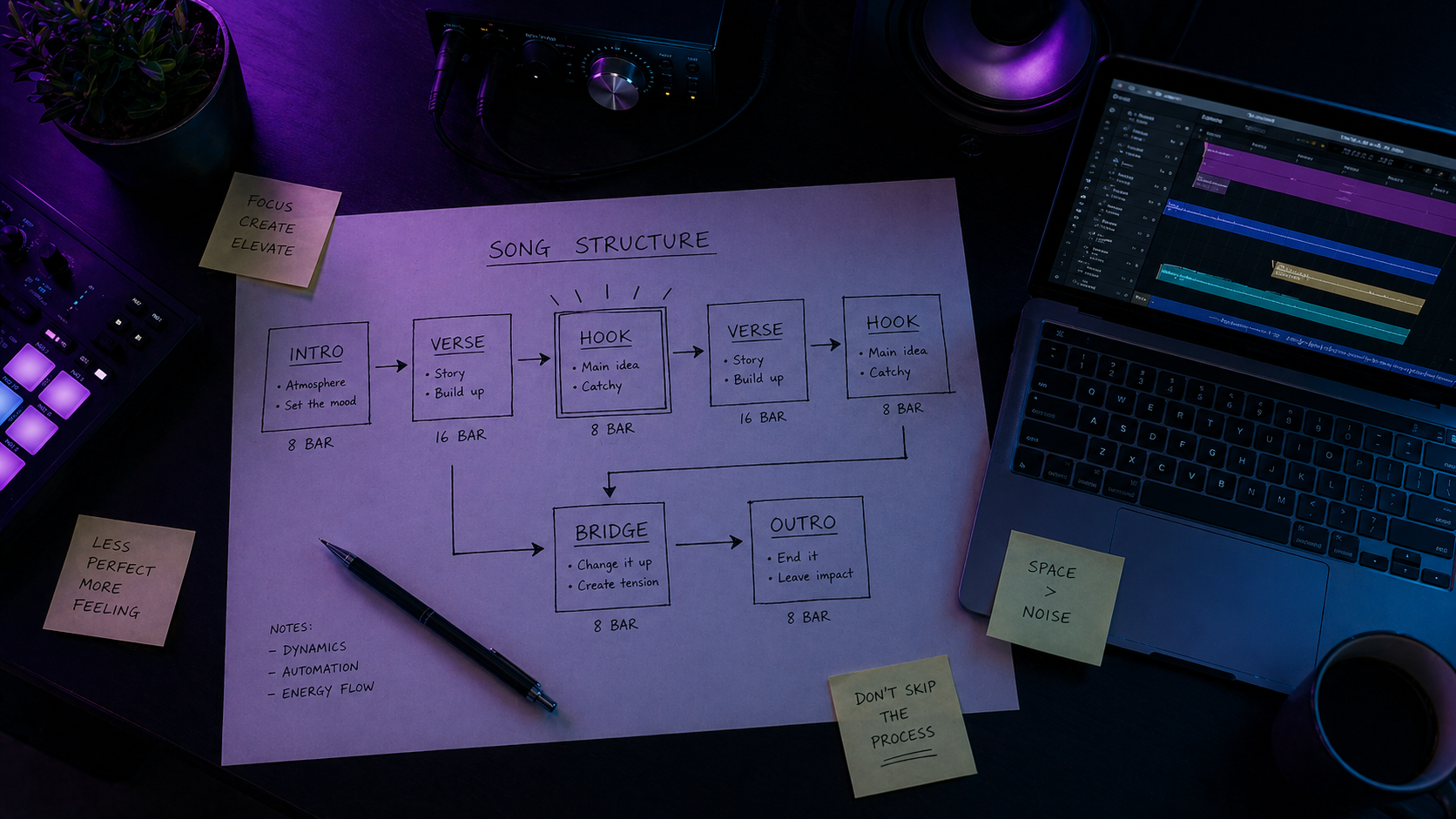
Understanding Song Structure: From Idea to Finished Track
Master rap song structure with proven templates for verses, hooks, and arrangements that keep listeners engaged from start to finish.
Building Your Home Studio Under $500
Home studio setup cheap: the exact gear, DAW, and acoustic treatment you need to record professional vocals for under $500.